
The Hidden Cost of Poor Master Data: Why Data Quality Is a Business Priority
Technology cannot deliver its full potential when the data behind it is unreliable. From ERP performance to AI-driven insights, poor master data creates hidden risks that affect profitability, compliance, and strategic decisions. For today's IT leaders, establishing data ownership, governance, and quality standards is not optional—it is a business imperative.
· 7 min read
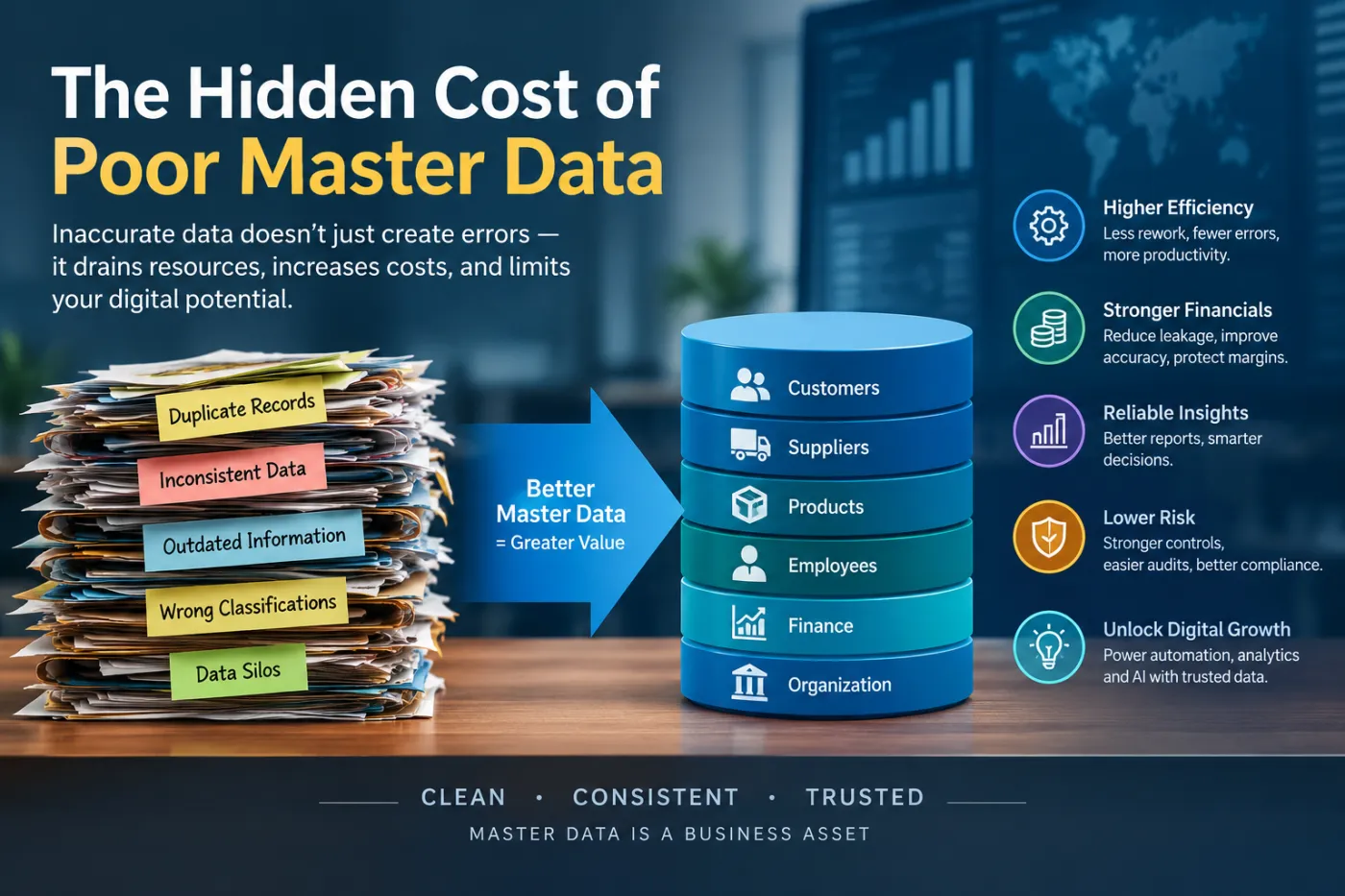
In today's digital economy, organizations invest heavily in ERP systems, business intelligence, automation, and artificial intelligence. Yet, one fundamental issue often remains overlooked: the quality of the data that powers these systems.
Poor master data may not appear to be an urgent business problem. Incorrect customer records, duplicate supplier profiles, inconsistent product codes, outdated employee information, and mismatched financial classifications can easily be dismissed as minor administrative issues. However, when these inaccuracies spread across an organization, they create hidden costs that affect operational efficiency, financial performance, compliance, and strategic decision-making.
The real cost of poor master data is not simply inaccurate information. It is the cumulative impact of every business decision, process, and system that depends on it.
1. Operational Inefficiency and Productivity Loss
When master data is inconsistent, employees spend valuable time correcting errors, reconciling records, verifying information, and repeating tasks that should be automated.
For example, duplicate supplier records can complicate procurement, create confusion during invoice processing, and increase the risk of duplicate payments. Inconsistent product codes can disrupt inventory management, while inaccurate customer records can lead to billing errors and delayed service delivery.
These activities consume resources without creating meaningful business value.
Over time, the organization pays twice: first for the original process and again for correcting the consequences of unreliable data.
2. Financial Leakage and Revenue Loss
Poor master data can directly affect an organization's financial performance.
Incorrect pricing information, outdated supplier terms, duplicate vendor accounts, inaccurate tax classifications, and inconsistent product descriptions can lead to payment discrepancies, revenue leakage, and unreliable financial reporting.
Even small errors can become significant when repeated across thousands of transactions.
Consider an organization operating multiple business units. If each unit maintains its own version of supplier, product, or customer information, consolidating financial results becomes more complicated. Finance teams must spend additional time reconciling discrepancies before management can trust the numbers.
A business cannot reliably control its costs or protect its margins when the underlying data is unreliable.
3. ERP Complexity and Integration Challenges
Enterprise Resource Planning systems are designed to integrate business functions through standardized processes and shared information. However, technology alone cannot guarantee data consistency.
When different departments maintain conflicting master records, the ERP system becomes a reflection of fragmented business practices.
Common consequences include:
-
Duplicate records across finance, procurement, inventory, and sales.
-
Failed or inaccurate integrations between enterprise applications.
-
Incorrect reports caused by inconsistent naming conventions and classifications.
-
Delays in system implementation, migration, and upgrades.
-
Increased customization and maintenance costs to compensate for data inconsistencies.
Master data quality should therefore be addressed before, during, and after ERP implementation. Otherwise, organizations risk automating existing data problems rather than eliminating them.
4. Unreliable Business Intelligence and Decision-Making
Business intelligence is only as dependable as the information behind it.
Executives rely on dashboards, KPIs, financial reports, and operational analytics to evaluate performance and allocate resources. If the underlying data contains duplicates, missing values, or inconsistent classifications, these insights can become misleading.
For instance, a supplier may appear under multiple names, causing procurement spending to be distributed across several records. Management may consequently underestimate total expenditure with that supplier and miss opportunities for contract negotiation.
Similarly, inconsistent product or business-unit classifications can distort profitability analysis and performance comparisons.
The danger is not always an obviously incorrect report. It is a convincing report that presents an inaccurate picture of reality.
5. Compliance, Audit, and Governance Risks
Master data plays a critical role in financial controls, regulatory reporting, internal audits, and organizational accountability.
Incorrect vendor details, incomplete customer information, inconsistent account mappings, and poorly controlled changes can weaken internal controls and make audit evidence more difficult to establish.
Without clear ownership and approval mechanisms, unauthorized or inconsistent changes may also introduce operational and financial risks.
Strong master data governance establishes who can create, modify, approve, and retire critical records. It also ensures that changes are traceable and that data standards are consistently applied across the organization.
Good governance is not merely a technical requirement. It is an essential component of enterprise risk management.
6. The Hidden Barrier to AI and Digital Transformation
As organizations adopt AI-powered analytics, automation, and intelligent business applications, master data quality becomes even more important.
AI systems can identify patterns, summarize information, and generate recommendations. However, when the source data is incomplete, duplicated, or inconsistent, the resulting insights may be unreliable.
An automated procurement workflow cannot consistently select the correct supplier if supplier records are fragmented. A forecasting model cannot produce dependable inventory recommendations if product identifiers and historical classifications are inconsistent.
Similarly, AI-generated management reports may communicate inaccurate conclusions with confidence when the underlying information is flawed.
AI does not eliminate the need for trustworthy data. It increases the importance of getting the data right.
Organizations that establish strong data foundations are better positioned to realize value from automation, analytics, and AI initiatives.
7. Building a Sustainable Master Data Management Strategy
Addressing poor master data requires more than a one-time data-cleaning exercise. It requires a structured approach that combines governance, technology, business ownership, and continuous improvement.
A practical master data management strategy should focus on the following priorities:
Establish clear ownership. Assign accountable data owners and operational data stewards for critical domains such as customers, suppliers, products, employees, chart of accounts, and organizational structures.
Define common data standards. Establish naming conventions, unique identifiers, mandatory fields, validation rules, and consistent classification structures across systems.
Create controlled data processes. Implement standardized workflows for creating, updating, approving, merging, and deactivating master records.
Measure data quality. Track completeness, accuracy, consistency, uniqueness, validity, and timeliness through measurable KPIs and regular reviews.
Integrate systems intelligently. Establish clear rules for authoritative data sources, synchronization, data ownership, and conflict resolution across ERP and other enterprise applications.
Build a culture of accountability. Make data quality a shared business responsibility rather than an isolated IT function.
The objective is not simply to maintain cleaner databases. It is to establish trusted, consistent, and reusable business information across the enterprise.
8. Measuring the Business Value of Better Data
Organizations should treat master data quality as a measurable business investment.
Useful indicators include duplicate-record rates, invoice exception rates, data correction hours, failed integration transactions, supplier onboarding time, inventory discrepancies, and financial reconciliation effort.
By establishing baseline measurements and monitoring improvements, leadership can identify where poor data creates the greatest financial and operational impact.
A mature approach also connects these indicators to business outcomes, such as reduced processing costs, improved reporting reliability, stronger internal controls, and faster decision-making.
This makes master data management easier to prioritize, fund, and sustain.
Conclusion: Data Quality Is a Leadership Responsibility
Poor master data rarely appears as a single, dramatic failure. Instead, its costs accumulate quietly through wasted employee time, financial discrepancies, unreliable reporting, integration challenges, compliance exposure, and underperforming digital initiatives.
These costs are often distributed across departments, making them difficult to recognize as one connected business problem.
Technology can improve processes, automation can accelerate execution, and AI can expand analytical capabilities. But none of these investments can consistently deliver their intended value without reliable data.
For IT leaders and business executives, the priority should be clear: establish ownership, enforce standards, strengthen governance, and make data quality part of everyday operations.
Because in a data-driven enterprise, master data is not merely an IT asset. It is the foundation of operational excellence, financial integrity, and sustainable digital transformation.
Share
Keep reading
Related articles
· 1 min read
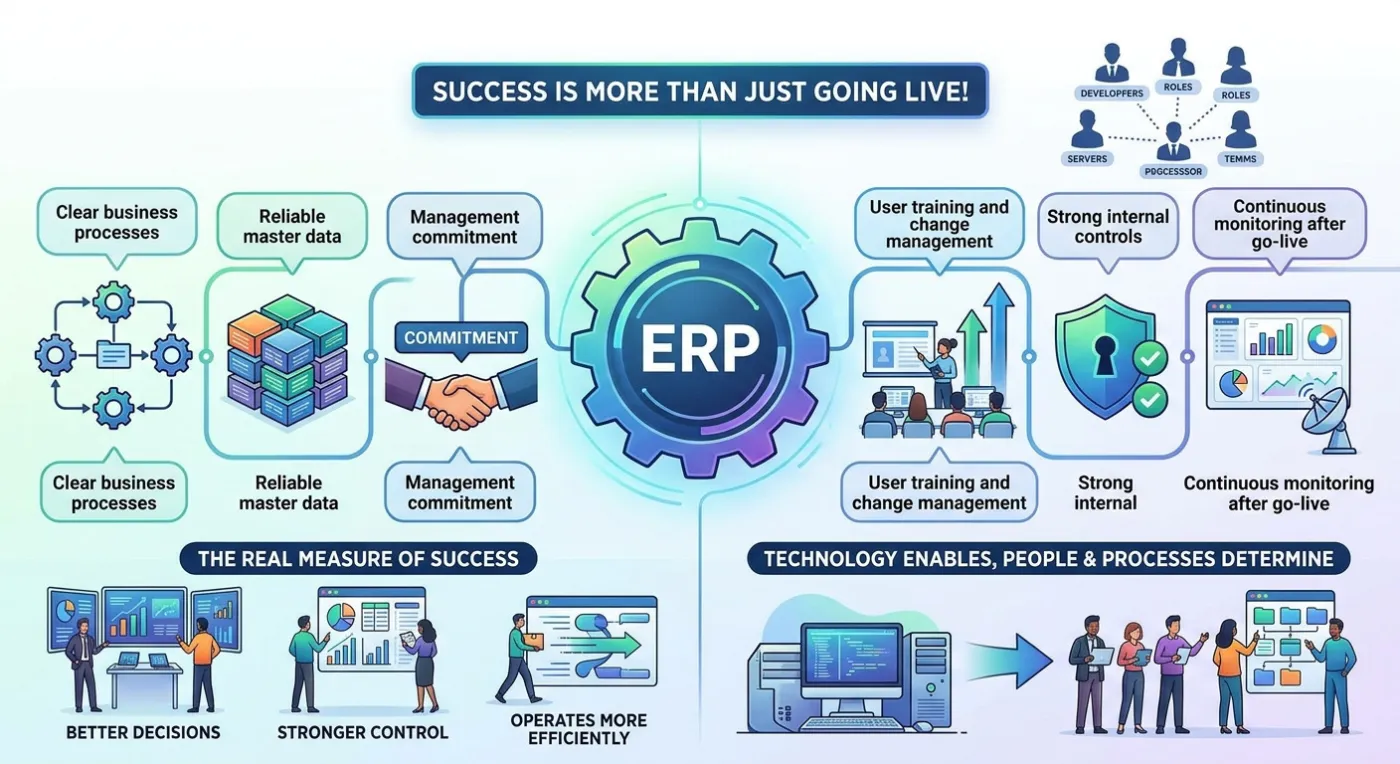
ERP Implementation Is Not an IT Project. It Is a Business Transformation
Going live is not the goal—business transformation is. A truly successful ERP implementation isn’t defined by software installation, but by clear processes, reliable data, and driving smarter decision-making across the organization.
ERP & Business Applications
· 6 min read
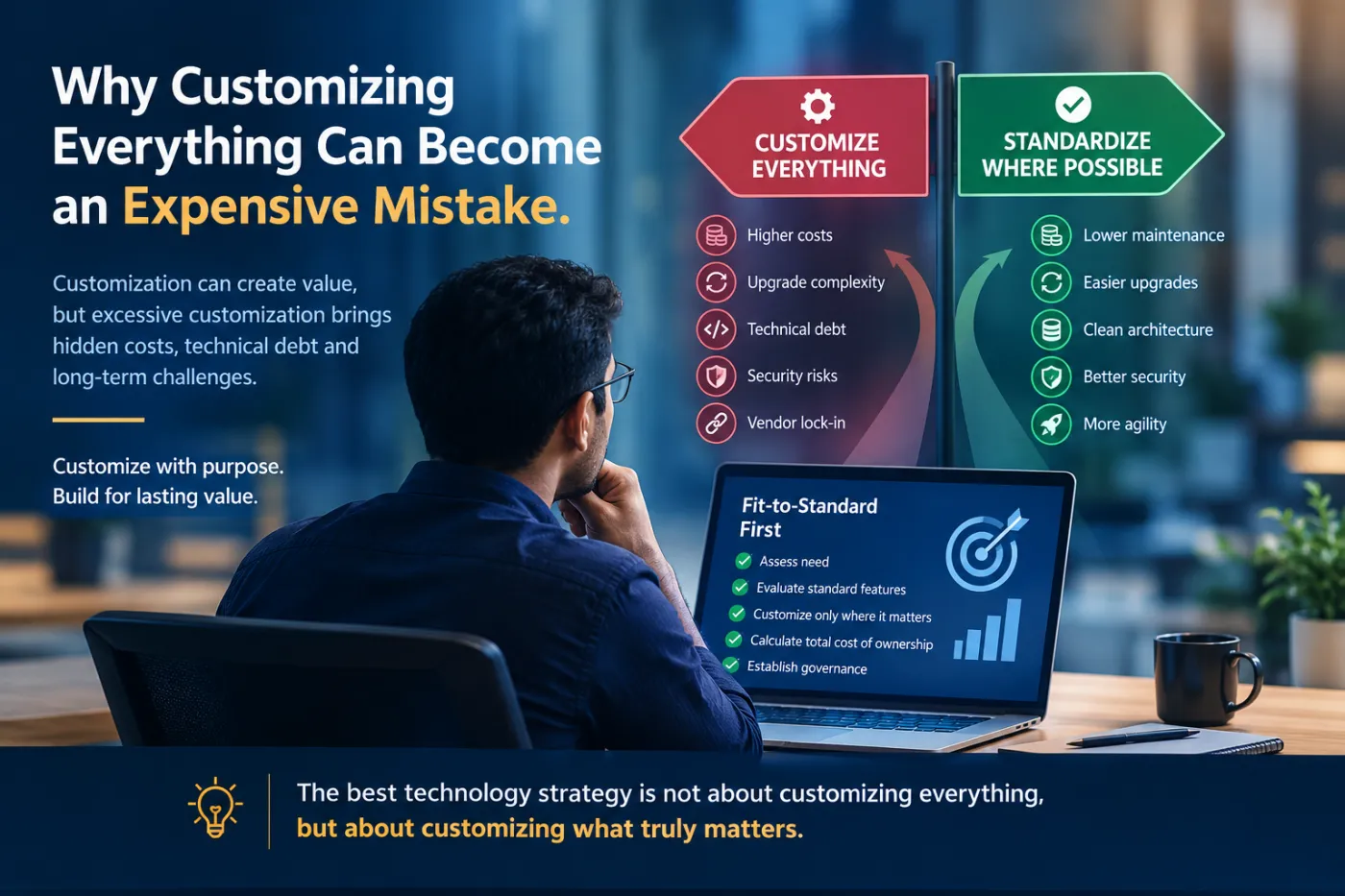
Why Customizing Everything Can Become an Expensive Mistake
Every customization comes with a cost beyond development. From security risks and vendor dependencies to expensive upgrades and ongoing maintenance, unnecessary modifications can undermine long-term digital transformation. Smart IT leadership prioritizes fit-to-standard approaches, measurable business value, and sustainable architecture—because the best technology strategy is not about customizing everything, but about customizing what truly matters.
ERP & Business Applications