
Why Empowering Your Team Matters More Than Controlling Every Task
Great leadership is not about controlling every task; it is about empowering people to take ownership, make decisions, and deliver results. By building trust, defining clear expectations, and encouraging accountability, leaders create teams that are more confident, productive, and capable of driving sustainable organizational growth.
· 6 min read

In leadership, one of the most common mistakes is believing that being involved in every decision, reviewing every detail, and controlling every task leads to better results. While close supervision may provide a temporary sense of security, it can gradually weaken the very team a leader is trying to strengthen.
Great leadership is not about controlling every action. It is about building a team that can make the right decisions, take ownership, and deliver results with confidence.
The Hidden Cost of Micromanagement
When leaders insist on approving every decision and monitoring every activity, employees may become reluctant to act independently. They begin waiting for instructions instead of identifying solutions. Even capable professionals may hesitate to take responsibility because they fear making mistakes or facing criticism.
Over time, this creates several organizational challenges:
-
Slower decision-making: Routine tasks become dependent on managerial approval.
-
Reduced innovation: Employees stop suggesting new ideas when they have little freedom to implement them.
-
Lower accountability: Team members focus on following instructions rather than owning outcomes.
-
Leadership bottlenecks: Managers become overwhelmed with operational details and lose time for strategic priorities.
-
Limited professional growth: Employees miss opportunities to develop judgment, confidence, and problem-solving skills.
The irony is that excessive control, intended to improve performance, can ultimately reduce productivity and organizational resilience.
Empowerment Builds Ownership
Empowering a team means providing people with clear objectives, appropriate authority, the resources they need, and the confidence to make decisions within agreed boundaries.
It does not mean abandoning oversight or allowing everyone to work without direction. Instead, it means shifting the focus from controlling activities to managing outcomes.
An empowered employee understands what needs to be achieved, why it matters, and how success will be measured. Within those boundaries, the employee has the freedom to determine the best way forward.
This approach creates a stronger sense of ownership. Team members become more proactive, raise problems earlier, explore better solutions, and take greater responsibility for results.
When people feel trusted, they are more likely to invest their skills, creativity, and energy in the organization's success.
The Role of Leaders Is to Create Clarity
Empowerment cannot succeed without structure. Teams need direction, expectations, and accountability.
Effective leaders establish a clear framework by defining:
-
Purpose: Why the work matters and how it supports organizational goals.
-
Expected outcomes: What success looks like and how it will be measured.
-
Decision-making authority: Which decisions employees can make independently and which require escalation.
-
Accountability: Who owns each responsibility and its final outcome.
-
Support mechanisms: How employees can access guidance, resources, and feedback when needed.
With these foundations in place, leaders can step back from unnecessary involvement without losing visibility or control over business-critical risks.
The objective is not to eliminate management. It is to make management more effective.
Empowerment in IT Leadership
In technology-driven organizations, empowerment is particularly important because systems, security requirements, customer needs, and operational challenges evolve continuously.
An IT leader who personally manages every technical issue, approves every minor change, and makes every operational decision quickly becomes a bottleneck.
A more effective approach is to establish clear processes, assign ownership, and allow capable professionals to manage their responsibilities.
For example, an infrastructure engineer should be empowered to resolve routine incidents within approved security and change-management policies. A software development team should have the freedom to recommend technical solutions within agreed architectural standards. Application owners should be accountable for service performance, documentation, and continuous improvement.
The IT leader remains responsible for governance, cybersecurity, resource allocation, risk management, and strategic alignment—but does not need to dictate every operational step.
This creates a more scalable IT function, improves response times, and gives the leader more capacity to focus on digital transformation and long-term business value.
Trust Must Be Supported by Accountability
Empowerment without accountability can create confusion. Accountability without empowerment can create frustration.
Successful leadership balances both.
Leaders should delegate decisions alongside clearly defined responsibilities, establish measurable performance indicators, and maintain appropriate review mechanisms. Regular check-ins should focus on progress, risks, lessons learned, and support—not on questioning every small action.
Mistakes should also be handled constructively. When an employee makes a reasonable decision in good faith, the priority should be to understand what happened, correct the issue, and improve the process. Repeated negligence or disregard for established controls, however, must be addressed appropriately.
This distinction creates an environment where people can take responsible risks without compromising organizational standards.
How to Move from Control to Empowerment
Leaders can begin with a few practical changes:
1. Delegate outcomes, not just tasks. Explain the objective and expected result, then allow employees to determine the execution approach within agreed boundaries.
2. Define decision rights. Make it clear which decisions can be made independently, which require consultation, and which must be escalated.
3. Replace constant monitoring with meaningful reviews. Use milestones, dashboards, service-level agreements, and regular discussions to maintain visibility.
4. Encourage initiative. Recognize employees who identify problems, propose improvements, and take ownership rather than rewarding only those who follow instructions.
5. Develop people deliberately. Provide coaching, feedback, and opportunities to handle increasingly complex responsibilities.
6. Lead by example. Demonstrate trust by listening to professional judgment, accepting constructive disagreement, and allowing team members to take credit for their achievements.
These changes do not need to happen overnight. Leaders can start with low-risk decisions, observe the results, and gradually expand decision-making authority as capability and confidence grow.
The Real Measure of Leadership
A leader's success should not be measured by how many decisions pass through their desk or how closely they supervise every employee. A more meaningful measure is the team's ability to perform effectively, solve problems independently, and maintain high standards even when the leader is not directly involved.
The strongest leaders build systems, develop people, and create an environment where responsibility is shared rather than concentrated at the top.
They understand that their role is not to be the person with every answer, but to help their team develop the capability to find the right answers.
Conclusion
Controlling every task may make a leader feel indispensable, but empowering a team makes the organization stronger.
When employees have clear direction, appropriate authority, and genuine trust, they become more confident, accountable, and capable of delivering meaningful results. Leaders gain the time and perspective needed to focus on strategy, innovation, and the future of the business.
The ultimate goal of leadership is not to build a team that cannot function without you. It is to build a team that can succeed because of the people, processes, and culture you have developed.
Because great leaders do not create dependence on themselves. They create the conditions in which others can lead, grow, and succeed.
Share
Keep reading
Related articles
· 1 min read
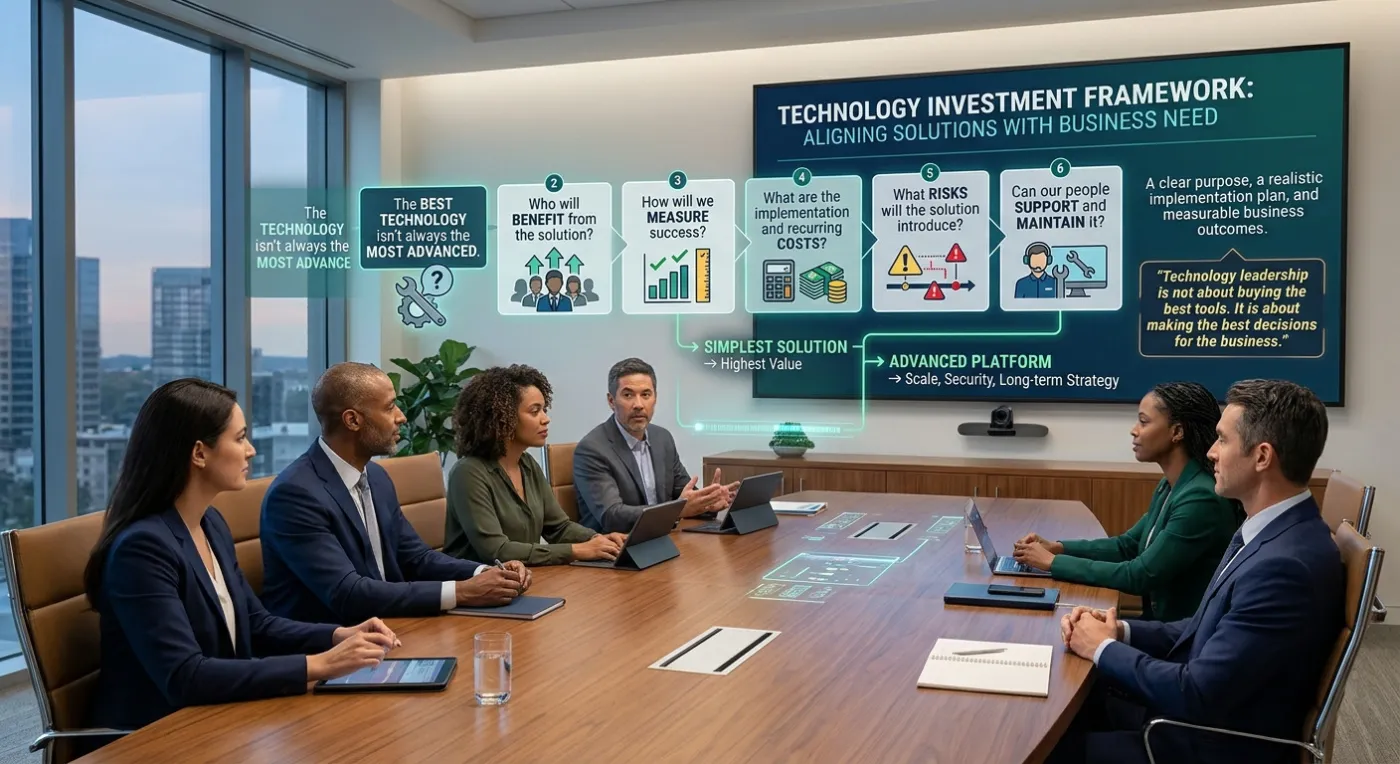
The business case matters more than the technology
Technology leadership is not about buying the best tools—it is about making the best decisions for the business. An impressive solution can still be a poor investment if it lacks a clear purpose, a realistic implementation plan, and measurable outcomes. Whether adopting a simple tool or an advanced platform, IT investments must be driven strictly by business needs, organizational readiness, and value delivery—not product popularity.
IT leadership
· 1 min read
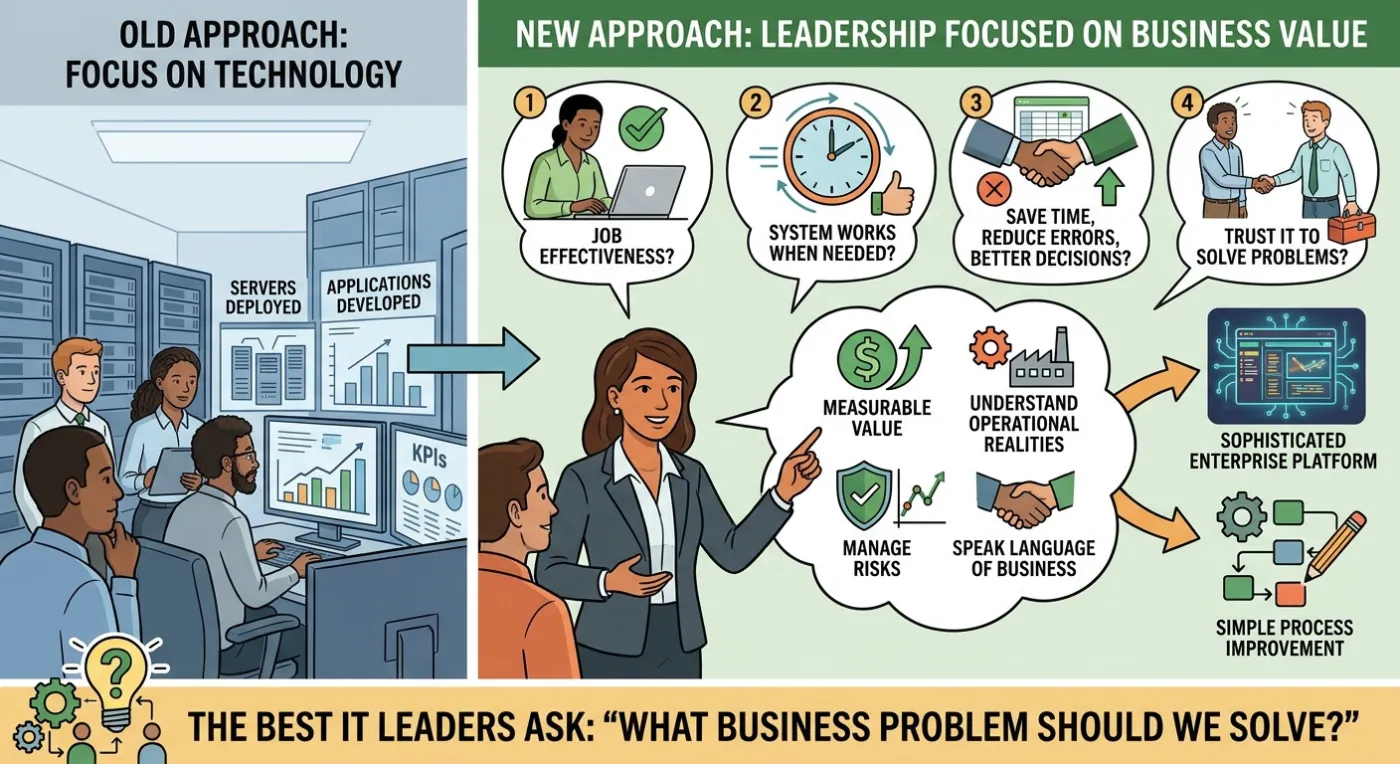
Managing IT in a Non-Technical Organization Requires a Different Kind of Leadership
When technology is not the company's core business, employees don't measure IT success by the number of servers deployed or applications developed. They measure it by something much simpler: Can they do their jobs effectively? Does the system work when they need it? Does technology help them save time, reduce errors, and make better decisions? Can they trust IT to solve problems?
IT leadership

· 1 min read
Leadership Is Not About Knowing Everything
True IT leadership isn’t about being the smartest person in the room or having every technical answer. It’s about asking the right questions, bridging the gap between technology and business strategy, and empowering team members to solve complex challenges independently. Real impact comes from taking accountability, sharing credit, and building resilient teams that thrive on continuous learning and ownership.
IT leadership