
IT Policies Are Useless If Employees Cannot Follow Them
Organizations often put a considerable amount of effort into developing security and compliance frameworks. However, if policies are overly complex, restrictive, or disconnected from everyday operations, they can lead to workarounds, shadow IT, and decreased compliance. Effective IT governance demands policies that align with human behavior, support business objectives, and make secure practices the simplest choice. Ultimately, the success of a policy should be evaluated not by how well it is written, but by how consistently it is followed.
· 5 min read
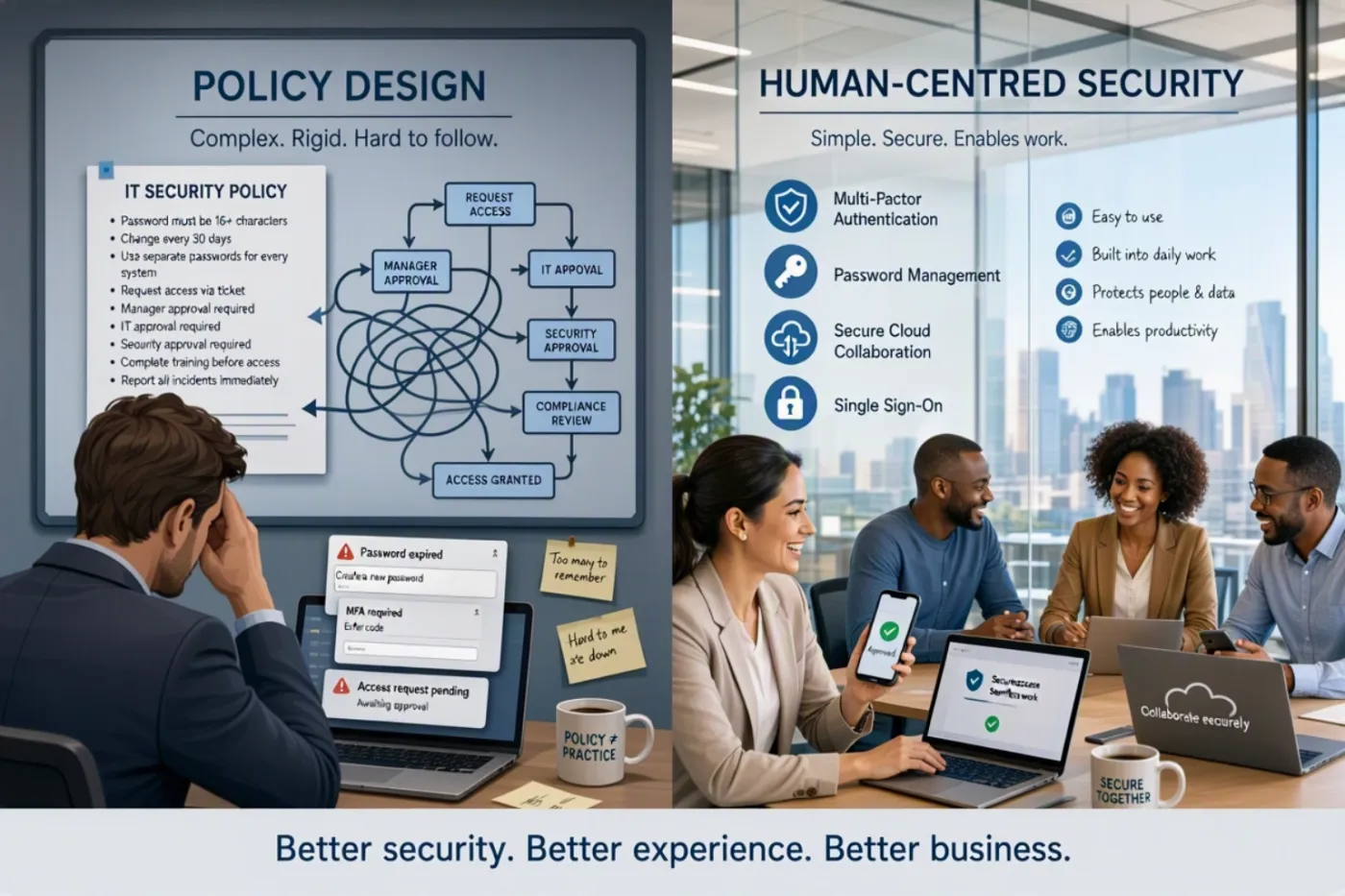
Organisations invest significant time and resources in developing IT policies to protect data, maintain compliance, and support business operations. These policies often cover areas such as information security, password management, remote working, software usage, data retention, and acceptable use of company systems. However, even the most comprehensive and technically accurate policy has little value if employees cannot realistically follow it.
A policy that exists only on paper does not improve security, reduce risk, or enhance operational efficiency. In practice, the effectiveness of any IT policy depends on how well it aligns with the daily realities of the people expected to follow it. If employees find policies confusing, impractical, or overly restrictive, they will eventually bypass them, creating greater risks than the policy was designed to prevent.
The Gap Between Policy and Practice
Many IT policies are written primarily from a technical or compliance perspective. While this approach ensures that regulatory requirements and security standards are addressed, it often overlooks user experience.
Consider a policy that requires employees to use complex passwords that must be changed every 30 days. While the intention is to improve security, employees may respond by:
- Writing passwords on sticky notes.
- Reusing slight variations of previous passwords.
- Saving passwords in unsecured documents.
- Frequently contacting the help desk for password resets.
In this situation, the policy may technically exist, but it fails to achieve its intended security objectives because it does not account for human behaviour.
The same problem occurs with:
- Overly restrictive access controls.
- Complicated approval processes.
- Excessive security prompts.
- Complex documentation requirements.
- Unrealistic reporting procedures.
When policies become obstacles to productivity, employees naturally seek alternative ways to complete their work.
Human Behaviour Is the Critical Factor
Technology alone cannot secure an organisation. People remain one of the most important components of cybersecurity and IT governance.
Employees generally want to do the right thing, but they also need to complete their responsibilities efficiently. If following a policy significantly slows down their work, many will prioritise productivity over compliance.
For example:
- A file-sharing policy may prohibit cloud storage solutions, but if approved alternatives are difficult to use, employees may resort to unauthorised services.
- A software installation policy may require lengthy approval cycles, encouraging staff to use personal devices or unapproved applications.
- A remote access policy may contain complicated authentication procedures that discourage compliance.
These workarounds, often referred to as "shadow IT," emerge when official processes fail to meet business needs.
Complexity Is the Enemy of Compliance
One common reason IT policies fail is excessive complexity.
Policies that contain technical jargon, lengthy legal language, or complicated procedures are difficult for employees to understand and remember. Staff members should not need specialised technical knowledge to comply with basic organisational policies.
Effective policies should be:
- Clear.
- Concise.
- Practical.
- Easy to understand.
- Easy to access.
A policy document spanning 50 pages may satisfy an auditor, but it is unlikely to be read thoroughly by most employees. Simplicity increases adoption and promotes consistent compliance.
The Importance of User-Centred Policy Design
Successful IT policies are designed with employees in mind. This means involving end users during policy development and considering their daily workflows, challenges, and operational requirements.
User-centred policy design focuses on questions such as:
- Can employees realistically follow this requirement?
- Does the policy support business operations?
- What obstacles might users encounter?
- Are there simpler ways to achieve the same security objective?
- Has the policy been tested in real-world scenarios?
Policies should enable secure behaviour rather than merely dictate it.
For example, instead of creating a complicated password policy, organisations can implement:
- Multi-factor authentication (MFA).
- Password managers.
- Single sign-on (SSO) solutions.
These technologies improve security while reducing the burden on users.
Training and Awareness Matter
Even a well-designed policy can fail if employees do not understand it.
Many organisations distribute policy documents during onboarding and assume compliance will follow automatically. In reality, staff members need ongoing education and reinforcement.
Effective awareness programmes should:
- Explain the purpose behind policies.
- Demonstrate practical compliance methods.
- Use real-world examples.
- Provide regular refresher training.
- Encourage questions and feedback.
Employees are more likely to follow policies when they understand how compliance protects the organisation, its customers, and their own work.
Measuring Policy Effectiveness
Organisations often measure whether policies exist, but not whether they are effective.
A better approach is to evaluate:
- Employee understanding.
- Adoption rates.
- Number of policy violations.
- Help desk requests related to policy requirements.
- User feedback.
- Security incident trends.
If a policy generates frequent exceptions, complaints, or non-compliance, the problem may lie with the policy itself rather than the employees.
Effective governance requires continuous review and improvement.
Balancing Security and Productivity
One of the greatest challenges in IT management is balancing security with operational efficiency.
Excessive security controls can hinder productivity, while insufficient controls increase risk. Successful organisations recognise that security measures must be integrated into workflows rather than imposed as barriers.
The most effective policies strike a balance by:
- Protecting critical assets.
- Minimising user friction.
- Supporting business objectives.
- Encouraging compliance through simplicity.
- Leveraging automation where possible.
Security that employees can consistently follow is far more valuable than perfect security that they routinely circumvent.
Conclusion
An IT policy is only as effective as its implementation. Organisations that focus solely on compliance documents without considering employee experience create policies that look good on paper but fail in practice. When policies are overly complex, unrealistic, or disconnected from daily work processes, employees inevitably find ways around them.
Successful IT governance requires policies that are clear, practical, user-friendly, and aligned with business operations. By designing policies that employees can realistically follow, organisations improve compliance, strengthen security, reduce operational risk, and create a culture of shared responsibility.
Ultimately, the goal of an IT policy should not be merely to establish rules, but to enable secure and efficient behaviour. If employees cannot follow the policy, the policy itself has failed.
Share
Keep reading
Related articles

· 2 min read
Why Access Reviews Matter More Than People Think?
Many organisations invest heavily in advanced cybersecurity tools, yet they frequently overlook one of the simplest security controls: regular access reviews. Over time, as employees shift roles and external contractors conclude their work, unmonitored privileges accumulate, leaving dormant or excessive permissions open. Technology and identity management systems alone cannot mitigate this risk; proactive governance is essential to constantly evaluate not just who holds access, but whether that access remains appropriate.
Cybersecurity & Governance
· 1 min read
An Audit-Ready Organization Is Built Every Day, Not One Week Before the Audit
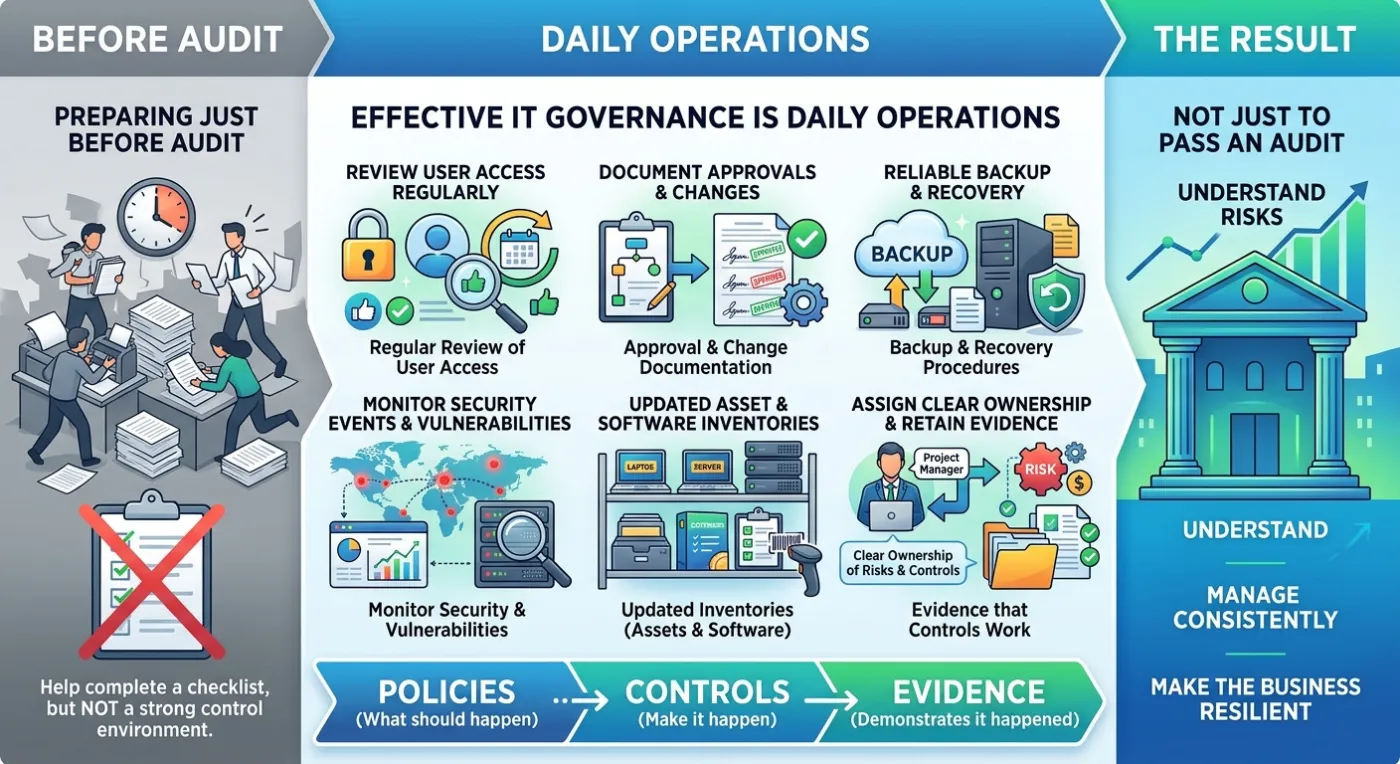
Effective IT governance is woven into the fabric of daily operations rather than assembled in a frantic scramble right before an audit. True control environments are built through consistent practices—such as regular user access reviews, meticulous approval documentation, reliable backup procedures, and clear risk ownership—transforming governance from a compliance checklist into an engine for operational resilience.
Cybersecurity & Governance

· 2 min read
Cybersecurity Is No Longer Just an IT Issue. It’s a Leadership Responsibility
For modern organizations, cybersecurity is no longer just about keeping systems operational—it is about protecting trust, sensitive data, and long-term business continuity. Because every digital interaction introduces potential privacy risks, enterprises must embed security into every layer of their operations, from cloud configurations to employee awareness. The fundamental challenge for IT leaders is not predicting if a cyber threat will occur, but ensuring the organization is fully prepared to prevent, detect, and respond when it does.
Cybersecurity & Governance